
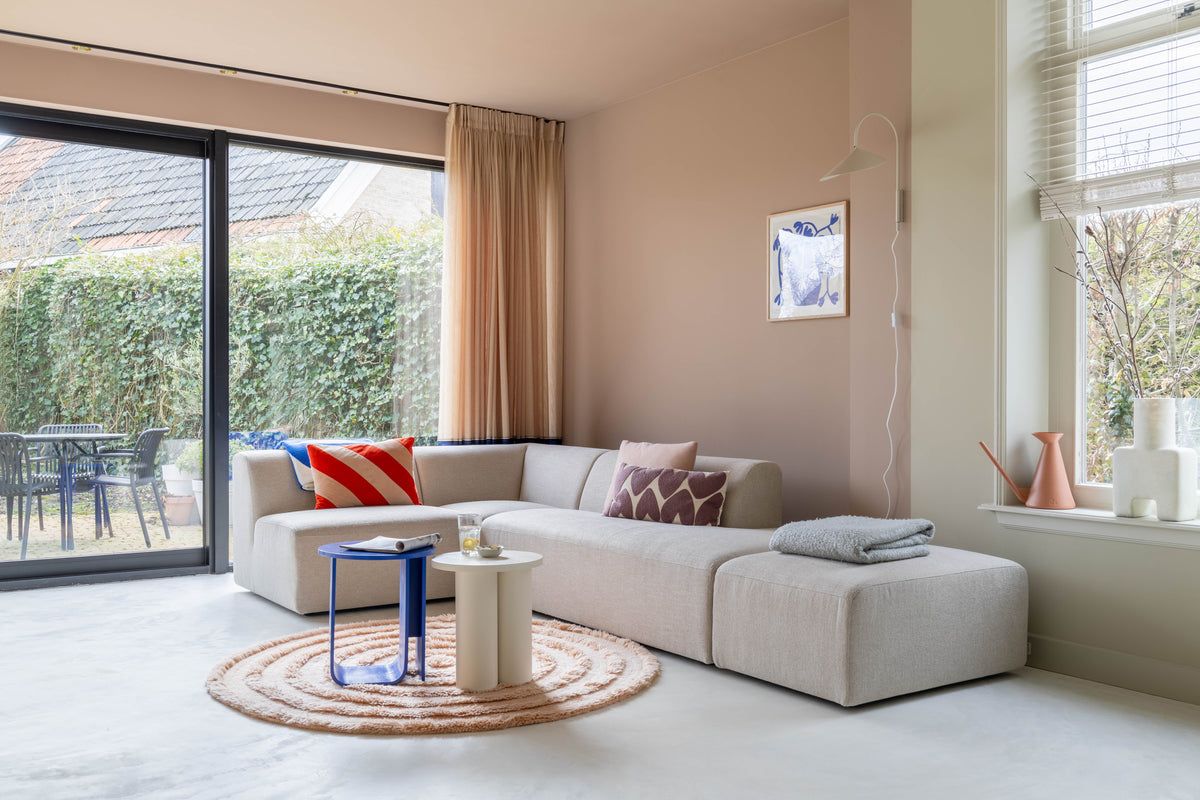
A small living room doesn't automatically call for the smallest sofa. Scale, shape and placement determine whether the space remains calm, open and pleasant. A compact straight sofa, clever corner sofa, lounge sofa or modular arrangement can therefore work better than a sofa that is too small with all sorts of loose extra seating around it. View the sofas for small spaces for compact models that fit well without compromising on comfort.
If you pay close attention to size, walkways and sightlines, you can compare much more effectively. Start by measuring exactly and checking the proportions; this helps with determining the sofa size for your living room. Below you will find practical advice on choosing the right size, sofa shape, design details and placement.
How to determine the right size and scale
When choosing a sofa for a small living room, it's not just about the width. The seat depth, the free space to walk past the sofa and the sightline from the door or kitchen also count. A sofa can look compact on paper, but still appear heavy if it is deep, high and massive.
Therefore, measure the wall first, but look beyond that. A sofa that takes up about two-thirds of the wall is often a good starting point, but there is no fixed rule. Leave enough space around it so that the room does not feel enclosed. In many cases, one well-scaled sofa looks calmer than several small seating pieces that divide the space. Even a larger sofa can work in a small living room, as long as the model remains airy and the layout feels open. Want to be sure how a model will look in your space? Try testing your favorite sofa in augmented reality and view it directly to scale in your room.
Which sofa shape best suits your layout?
Corner sofa in a small living room: yes, but choose wisely
Yes, a corner sofa can fit perfectly in a small living room, as long as the corner makes logical use of the space and the walkway remains clear. In a compact, more square room, this often works better than in a narrow living room, where a straight sofa or chaise longue usually looks calmer.
If you want the comfort of lounging but not the bulk of a large corner sofa, look at small corner sofas or a modular corner arrangement. Also pay close attention to left or right corner: that choice should match your sightline, the window side and the daily route through the room. Not sure? Read more about the trade-offs in whether or not to have a corner sofa in a small living room.
These design details make the space feel airier
It's not just the shape of the sofa that counts. Small design choices can also make a small living room look larger or make it look fuller.
- High legs and an open underside show more of the floor. This often immediately creates a more spacious effect.
- A lower back and slimmer armrests keep the silhouette calmer than wide, blocky models.
- Rounded lines can look softer than sharp, massive corners, especially in a compact seating area.
- Light upholstery often looks more open. Dark shades or leather can be very stylish, but require more balance in the rest of the space so that the whole does not become too heavy.
- Practical flexibility counts extra in small living rooms. Think of modular sofas or a footstool that you can move when you need extra seating.
- Look beyond just appearance: a beautiful small corner sofa must also fit how you sit, lie down and move through the room daily.
How to place your sofa without losing valuable space
The best place for a sofa depends on the shape of your room, not on the rule that it must always stand against the wall.
- Against the longest wall often works well in a narrow living room and keeps the room tidy.
- Slightly away from the wall can actually give more air, as long as you don't create an awkward empty strip.
- In a corner or alcove you use the space efficiently, especially with a compact corner sofa or lounge sofa.
- Free in the space can be clever in an open living space to define the seating area. Two sofas in a small living room only work if sightlines and walkways remain truly spacious enough.
These mistakes make a small living room unnecessarily full
- Choosing a model that is too heavy with wide armrests, a high back or a massive base.
- Only looking at the outer dimensions or seating places and forgetting depth, proportions and daily use.
- Automatically placing the sofa tightly against the wall, while placing it slightly looser sometimes actually works more spaciously.
- Overloading the seating area with extra chairs, side tables and accessories, making the room feel busy and smaller.
